A Closer Look at Hospitality FF&E procurement planning
Hospitality FF&E procurement links design approvals, suppliers, construction readiness, shipping, installation, and hotel operations. A single item register and decision calendar help teams see dependencies before they affect room release.
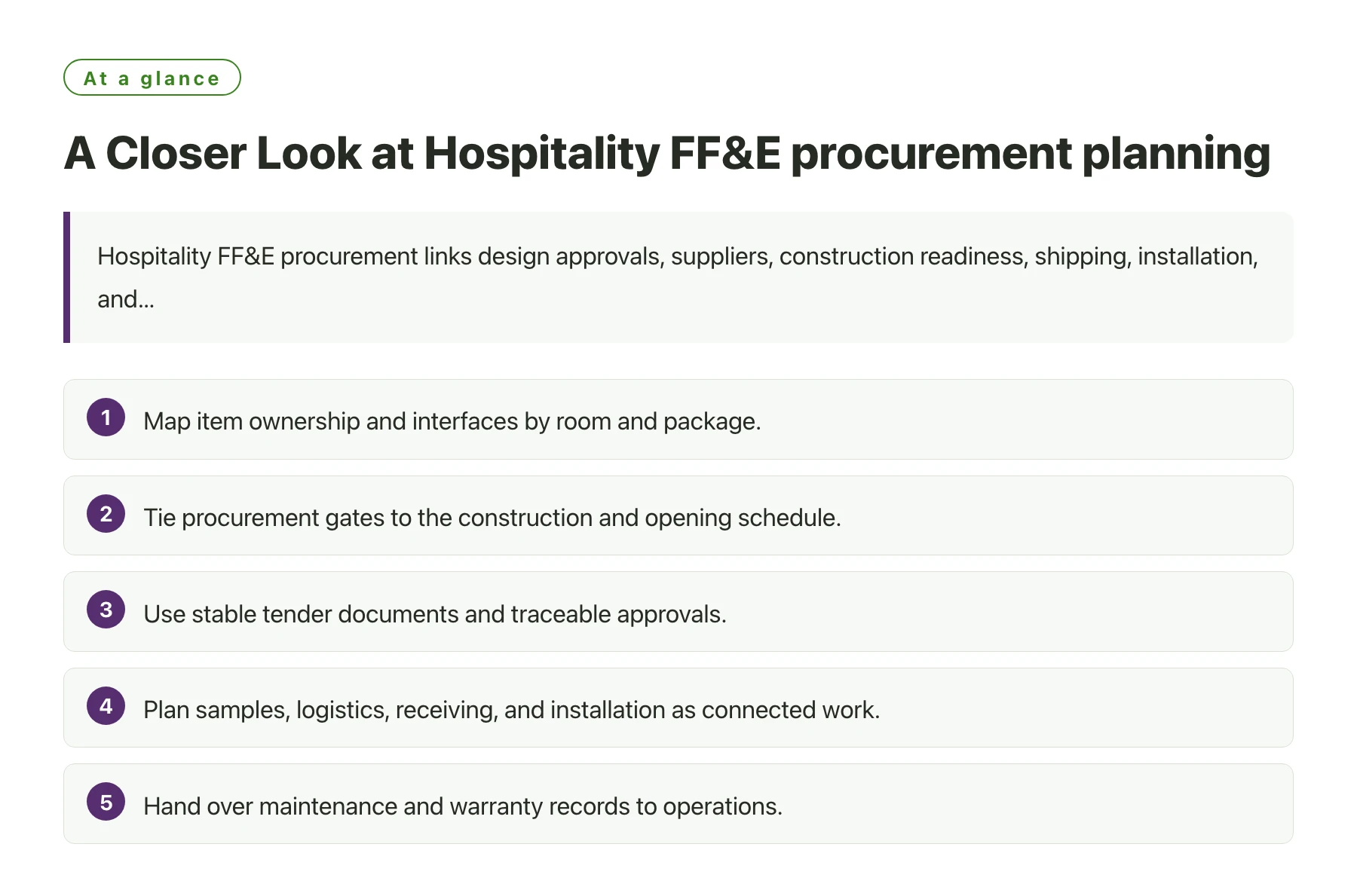
Key takeaways
- Map item ownership and interfaces by room and package.
- Tie procurement gates to the construction and opening schedule.
- Use stable tender documents and traceable approvals.
- Plan samples, logistics, receiving, and installation as connected work.
- Hand over maintenance and warranty records to operations.
The FF&E programme succeeds when each item is approved, delivered, installed, and ready for use in the right space and sequence.
1. Set the project outcomes and package map
A hospitality FF&E plan should connect brand intent, guest use, construction interfaces, procurement budget, and opening date. Begin by listing guestrooms, suites, public spaces, food and beverage areas, meeting rooms, and back-of-house zones. For each area, identify which items the FF&E package includes and which belong to a contractor, operator, or specialist vendor.
Create a package map with accountable buyer, designer, supplier, installer, and approval owners. Note shared systems such as room controls, lighting, appliances, and bedside power. An item without an owner can disappear from the budget or arrive without its required connection or installation service.
2. Build a decision calendar around the critical path
Work backward from room handover and opening. Include design freeze, item schedule, bid issue, clarifications, award, shop drawings, finish samples, mock-up, production release, factory checks, freight, receiving, installation, commissioning, snagging, and operator training. Show dependencies and buyer review time at each gate.
Flag custom pieces, imported finishes, specialty lighting, and long-lead equipment. Ask each supplier for a schedule with start triggers, evidence, and recovery options. Compare its assumptions with the construction programme and identify which approvals or site decisions would delay production if they slip.
3. Control room standards and quantity takeoff
Develop a room-type matrix with furniture and equipment by key, standard, suite, accessible room, and public-area category. Identify quantities per room, total project quantity, spare allowance, and alternate layouts. Link each line to drawings and a current item code so the schedule remains usable during tender and receiving.
Confirm actual dimensions through site surveys, especially in renovation or phased work. Record doors, corridors, lifts, ceiling height, wall construction, outlet locations, plumbing, and installation clearances. If the site differs from design drawings, route changes to the designer before suppliers finalize shop drawings.
4. Issue a complete and comparable tender package
Give bidders the same item schedule, specifications, finish references, drawings, delivery assumptions, installation scope, and response form. Mark mandatory requirements and acceptable alternatives. Request unit and extended prices, currency, quantity breaks, tooling, samples, lead time, payment, warranty, spare parts, packaging, and exclusions.
Require item-by-item responses for deviations and evidence. Ask for shop drawing examples, product data, material options, and a proposed submittal schedule. The bid should identify who manufactures, exports, coordinates, and installs each item, especially where the bidder relies on subcontractors.
5. Review suppliers and their operating model
Verify the contracting entity, factory locations, product-category experience, export role, subcontractors, and customer references. The U.S. Department of Commerce recommends due diligence when evaluating foreign business partners; apply proportionate checks and record the source and date of important findings. [1]
Review evidence tied to projects with similar product types, room quantities, customization, delivery phasing, and site constraints. Ask who manages design coordination, consolidation, packing, issue escalation, and corrective action. A broad hotel reference is less useful than evidence about the work the supplier will actually perform.
6. Coordinate submittals and design approvals
Create a submittal register by item code, required document, owner, issue date, reviewer, due date, and status. Separate design approval, technical review, sample acceptance, code or compliance review, commercial approval, and production release. Avoid treating one signature as approval of every project dimension.
Select mock-up rooms and representative samples to confirm scale, finish, comfort, cleaning, durability expectations, access, and interface fit. Record comments against the applicable item and drawing revision. A mock-up may reveal coordination changes, so reserve schedule and budget for revisions before mass production.
7. Compare cost beyond the purchase price
Build a total-cost view that includes product price, sample and tooling charges, packaging, freight, insurance, duties, warehousing, local delivery, assembly, installation supervision, commissioning, spares, and waste removal. Mark estimates separately from fixed prices and record which quantities or assumptions support each total.
Assess cost by room or project phase to make scope gaps visible. Compare supplier-installed, contractor-installed, and owner-installed alternatives where allowed. If a lower-cost option changes finish, warranty, delivery, or maintenance, show that tradeoff as a separate decision instead of burying it in an average unit price.
8. Align quality, logistics, and receiving
Define inspection gates for materials, dimensions, finish, function, packing, and quantity. Set evidence required before shipment, process for damage or shortages, and authority to approve a concession. Identify fragile or custom items that need stronger protection or extra time for replacement.
Sequence carton labels and packing lists by building, floor, room, and installation order. Confirm receiving appointments, unloading equipment, staging space, storage conditions, elevator access, and site distribution. The hotel team should be able to locate each item without opening unrelated cartons or disrupting completed spaces.
9. Prepare installation and operator handover
Specify who unloads, moves, assembles, anchors, adjusts, commissions, cleans, and removes packaging. Confirm installer access, tools, working hours, protection of finished surfaces, and coordination with other trades. Record room-level completion and outstanding snags before accepting a phase.
Collect maintenance instructions, warranty contacts, spare-part numbers, finish codes, control settings, and training records. Pass the final approved submittals and as-built information to operations. A procurement plan is incomplete if the hotel cannot maintain, repair, or reorder the installed FF&E after opening.
10. Manage decisions and changes through closeout
Maintain a decision log and risk register for open finishes, long-lead items, site measurements, supplier changes, construction readiness, and logistics. Every change request should show price, schedule, quality, and interface impact and receive approval from the person with authority before production proceeds.
Teams comparing Learn more can use a single FF&E calendar and item register to coordinate suppliers, samples, freight, installation, and handover. Confirm the current procurement support scope directly, then review each phase against approved documents and room acceptance criteria.
Sources
Frequently asked questions
What is the first step in hospitality FF&E procurement planning?
Set package boundaries, project outcomes, room standards, decision owners, budget assumptions, and opening milestones.
When should hotel suppliers receive the FF&E tender?
Issue it when the item schedule, specifications, drawings, and delivery assumptions are sufficiently stable for comparable offers.
How do I prevent FF&E items from missing the opening date?
Map approvals and production dependencies to room handover, flag long-lead items, and monitor evidence-based supplier milestones.
What belongs in the FF&E handover to hotel operations?
Provide approved product data, maintenance instructions, finish and part references, warranties, service contacts, and training records.