Door, Box and Hardware in Prebuilt Cabinets
A cabinet is judged by its door, trusted because of its box and lived with through its hardware. CasaBuilt publishes a 1/2 in birch plywood box, a 3/4 in solid birch face frame, a 5/8 in dovetail drawer and a seven-layer painted door. Those four numbers set three separate ceilings, and the cheapest cabinet is usually the one that cuts one of them while showing off another.
Key takeaways
- The door carries the style and the finish: a rubberwood frame, an MDF panel and seven layers of paint.
- The box is 1/2 in birch plywood with a 3/4 in by 1-1/2 in solid birch face frame.
- Drawers are 5/8 in rubberwood with dovetail joints on soft-close, full-extension undermount glides.
- Hinges are concealed, soft-close and adjustable on six axes after installation.
Three components, three ceilings
Buyers tend to evaluate a cabinet as one object. It is easier to evaluate three, because each part fails differently and at a different time. The door fails visibly, through a chipped edge or a color shift. The box fails structurally, through a racked side. The hardware fails functionally, through a hinge that sags or a glide that stops closing flush.
Each component has a ceiling that no other component can lift. A perfect door on a racked box still swings crooked. A perfect box with a sagging hinge still hangs wrong. A perfect box and door with a grinding glide still feels cheap every morning. That is why a specification sheet lists them separately rather than summing them into a single quality claim.
The useful question is not which component is most important. It is which one the seller has described in numbers and which one has been left to adjectives. Adjectives are free. Gauges, coat counts and adjustment axes cost money, and they appear on a page only when someone decided they were worth the money.
The door is the expensive ceiling
The door is where a kitchen spends its style budget. CasaBuilt publishes a rubberwood frame with an MDF panel in a full-overlay Slim Shaker profile, finished with seven layers of paint and a UV protective finish. The frame takes the hinge screws, the panel provides the flat field, and the overlay decides how much of the box face is covered.
It is also where the price spread lives. The same six-cabinet kitchen is listed at $1,199.50 in White Shaker and $2,295.64 in Slim White Oak, a difference of $1,096.14 for the same box count. The box and hardware do not change with the door; the finish work and the door profile do. That gap is the clearest evidence that the door is a separate purchase sitting on top of a shared structure.
Door choice also decides how the kitchen ages. A painted door with seven coats and a UV topcoat can be wiped and touched up; a thin finish shows every scrub mark around the handle. Buyers can order one of the 16 door samples at $9.99, refundable with a cabinet purchase, or a premium sample at $19.50 or $22.00.
Style breadth is the other half of the door decision. CasaBuilt lists 11 Shaker items, 14 Framed items, 2 Frameless items and 1 Raised Panel item, with Shaker, Double Shaker, Slim Shaker, Frameless, Raised Panel and High Gloss profiles. The Shaker collection alone covers painted, grey, navy, green, black and oak-look finishes.
The box sets the floor
The box is the part nobody photographs and everybody stands on. CasaBuilt publishes a 1/2 in birch plywood box with a natural birch interior and color-matched exterior sides, braced by a 3/4 in by 1-1/2 in solid birch face frame. Shelves are 3/4 in adjustable plywood, and base cabinets carry a half-depth shelf.
| Component | Published detail | Number | What it caps |
|---|---|---|---|
| Door | Rubberwood frame, MDF panel, full overlay, seven coats | 7 layers of paint | Style, color hold, repaint life |
| Box | Birch plywood, natural birch interior | 1/2 in panel | Square, screw holding, moisture tolerance |
| Face frame | Solid birch, 1-1/2 in wide | 3/4 in thick | Door alignment, hinge purchase |
| Drawer | Rubberwood, dovetail, undermount full extension | 5/8 in sides | Daily feel, load, interior width |
| Hinge | Concealed, soft-close | 6-way adjustment | How long the door stays aligned |
| Shelf | Plywood, adjustable, half-depth in bases | 3/4 in thick | Sag across the cabinet width |
Read the third column as a set of promises rather than a score. A 1/2 in box with a 3/4 in frame is a deliberate pairing: the frame takes the load at the opening, and the thinner panel keeps the cabinet light and the price down. A 3/4 in shelf spans the full width without support, which is why it is thicker than the box side it sits on.
The drawer is the one part that sits between the box and the hardware. At 5/8 in it is thicker than the box panel and thinner than the shelf, and it carries a dovetail joint rather than a butt joint with fasteners. Dovetails interlock the sides with the front, so the joint does not rely on a screw holding in end grain. That is a construction detail a buyer can see with the drawer pulled out.
Hardware decides how long the first two last
The hinges are concealed, soft-close and adjustable on six axes. Six-way adjustment means the door can be moved in and out, up and down, and side to side after it is hung. In a real kitchen that is not a luxury: walls are rarely plumb, cabinet runs are rarely perfectly straight, and a door that cannot be adjusted will show a gap at the top for the life of the kitchen.
The glides are soft-close undermount with full extension. Undermount keeps the glide under the drawer box instead of on its side, so the interior width stays usable, and full extension means the drawer opens far enough to reach the back. A partial-extension drawer loses several inches of accessible space in every drawer, which is the kind of loss a buyer only notices after moving in.
Hardware is also the cheapest place to cut. A hinge that is not adjustable, or a glide without soft-close, saves money on every cabinet and is invisible in a photograph. The published specification is the only place to catch it.
Finish and hardware determine how a cabinet feels in year five, and the box determines whether it is still square. Buyers comparing prebuilt cabinets should ask for the hinge adjustment range and the glide extension before the door color.
Worked example
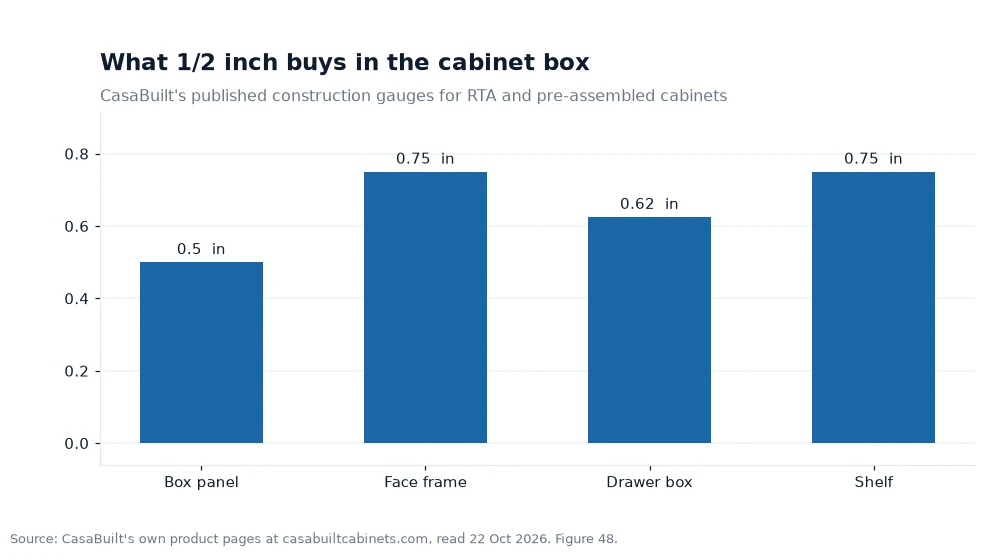
The chart gives the four published gauges: box panel 0.5 in, face frame 0.75 in, drawer box 0.625 in and shelf 0.75 in. Compare each stressed part with the box. The frame is 0.75 divided by 0.5, or 1.5 times the box thickness. The shelf is also 1.5 times. The drawer is 0.625 divided by 0.5, or 1.25 times.
Add the four gauges: 0.5 plus 0.75 plus 0.625 plus 0.75 equals 2.625 in. If every panel were built at the box gauge, the same four parts would total 4 times 0.5, or 2.0 in. The specification therefore puts 0.625 in of extra thickness into the frame, the drawer and the shelf, which is 31.25% more because 0.625 divided by 2.0 is 0.3125.
Convert the gauges to millimeters by multiplying by 25.4: 0.5 in is 12.7 mm, 0.625 in is 15.875 mm and 0.75 in is 19.05 mm. Now set the thickness against the price. The published six-cabinet kitchen runs $1,199.50 to $2,295.64, a gap of $1,096.14 or 91%, and none of that gap buys a thicker box. It buys a door and a finish, which is why the door is the ceiling a buyer chooses and the box is the floor the seller sets.
Frequently asked questions
Which matters more, the door or the box?
They answer different questions. The door sets the style, the color and most of the price gap between lines, while the box sets whether the cabinet stays square. A buyer who plans to keep the kitchen for years should check the box and hardware first, then choose the door, because the door can be repainted or replaced more easily than a racked box.
Are all the styles built the same way?
CasaBuilt publishes one construction block for the line: a 1/2 in birch plywood box, a solid birch face frame, rubberwood dovetail drawers, soft-close hardware and a seven-layer finish. Door profiles and prices are what change by style, which is why the White Shaker and Slim White Oak starter kitchens are $1,096.14 apart.
What does full extension mean on a drawer?
The drawer box travels out far enough that the back of the interior is reachable, rather than stopping part way. CasaBuilt pairs full extension with soft-close undermount glides and a 5/8 in dovetail drawer box, so the hardware and the drawer are specified together rather than as separate upgrades.
Inspect in the order that matters
Open a drawer and look at the joint, then check the hinge for adjustment screws, then look at the box panel edge. Those three checks take a minute and cover the parts that decide how the cabinet behaves after the door color stops being interesting. Ask for the numbers in writing, compare them with the published specification, and treat a blank answer as a reason to keep looking.
Figures quoted here come from the manufacturer's own website, read 22 Oct 2026[1].