ODM Fragrance Development: The Process, Step by Step
An ODM project hands the formulation work to the manufacturer, but it does not hand over the decisions. The brand still owns the brief, the approval, the price architecture and the pack, and every one of those can stop a project that is otherwise running on schedule. The process below is the sequence most ODM projects follow, with the deliverables that should exist at each stage, so a brand can tell the difference between progress and activity.
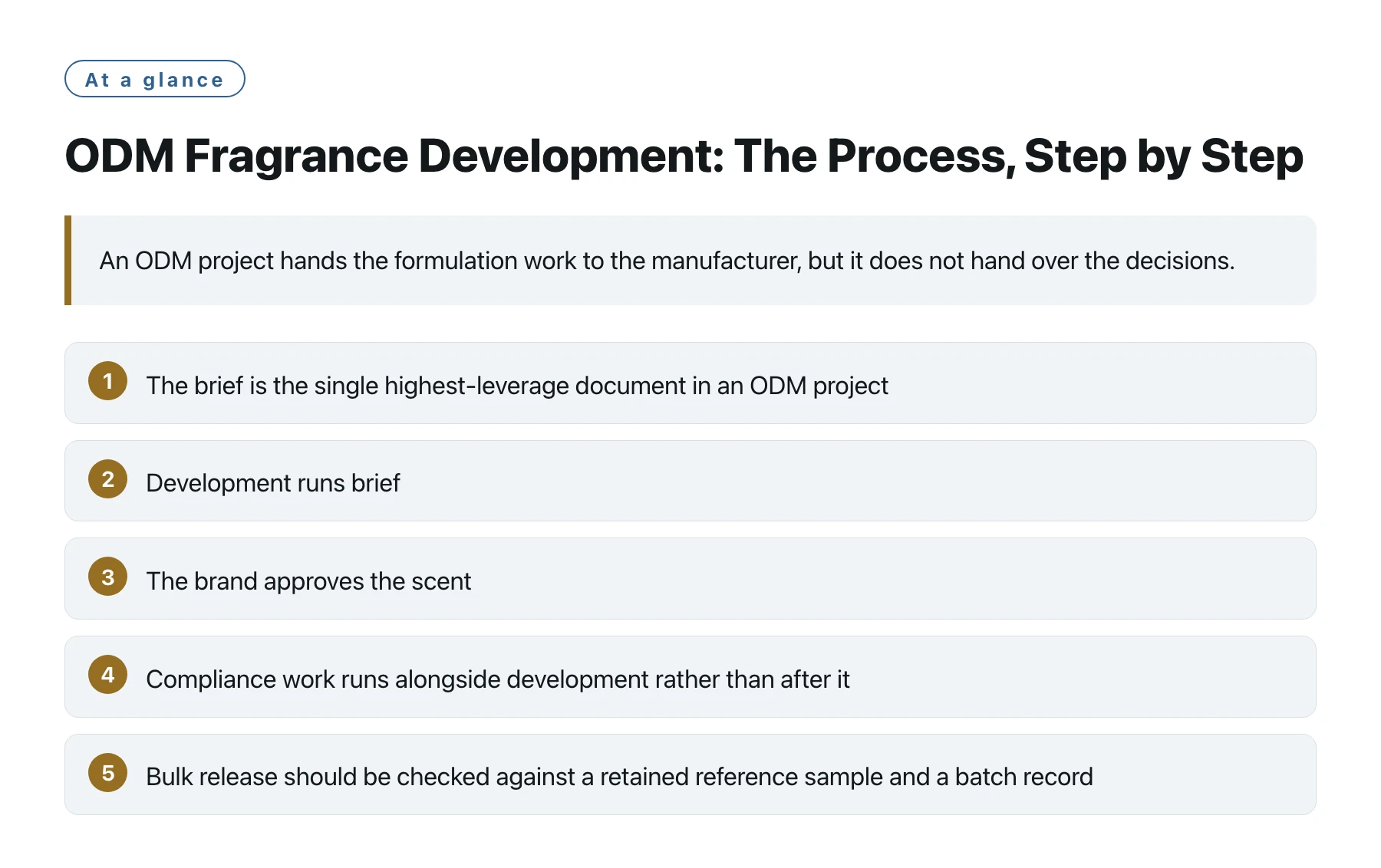
Key takeawaysThe brief is the single highest-leverage document in an ODM project; a precise one removes trial rounds and weeks. · Development runs brief, screening, trials, revision and selection, and each stage should end with a physical or written deliverable. · The brand approves the scent, the pack and the price architecture; the manufacturer owns the formula, the process and the production risk. · Compliance work runs alongside development rather than after it, because a restricted material can invalidate a selected direction [1]. · Bulk release should be checked against a retained reference sample and a batch record, not against a photograph or a memory.
Brands come to ODM for a practical reason: the manufacturer already has a palette, a bench and a production line, and the brand does not have to build any of that. What is less well understood is how much of the project is still the brand's to decide.
A well-run ODM process is unusually transparent about this. It puts a deliverable at the end of every stage, so both sides can see whether the project is where it should be. The stages below are written from the manufacturer's side of the table, but the checklist works for the buyer too.
Two warnings before the sequence. First, the brief determines how many trials are needed, so it is the cheapest place to invest time. Second, compliance is a design constraint rather than a final inspection.
The sequence, with the deliverable at each stage
- Brief. The brand states the scent family, the intended market, the price ceiling, the pack format and the materials to avoid. Deliverable: one page signed by both sides.
- Screening. The manufacturer matches the brief against existing bases and directions and proposes two or three to smell. Deliverable: a numbered shortlist with a description of each.
- Trial. The chosen directions are built into trial formulas at the target concentration. Deliverable: coded samples with a date and a formula reference.
- Revision. The brand returns written notes naming a direction and a magnitude. Deliverable: a revised sample plus a note of what changed.
- Selection and costing. One direction is chosen and costed at the planned volume, including the pack. Deliverable: a formula reference, a specification and a landed unit price.
- Compliance and pack. The formula is checked against the destination market's requirements while the pack and artwork are developed in parallel. Deliverable: a documented review and approved artwork.
- Bulk production and release. The batch is produced, filled and checked against the specification. Deliverable: the batch record, a retained reference sample and the release documents.
The brief is a specification, not a mood board
Most delays in ODM development trace back to a brief that could be read two ways. A direction, an intended market, a price ceiling and a list of exclusions are the four pieces of information a perfumer actually needs; everything else is context.
It also helps to name what the fragrance must not do. A brand launching into a crowded category usually knows which reference points it does not want to resemble. Saying so costs nothing and saves trials, because it removes whole areas of the palette before the bench work starts.
A partner such as Xuelei ODM fragrance manufacturer will normally push back on a brief that is too broad, and that pushback is a useful signal. A supplier that accepts an ambiguous brief without comment is usually planning to return with a sample and hope.
Write the exclusions down
Some exclusions are commercial and some are legal. The commercial ones are the brand's own taste. The legal ones come from the industry's restriction framework: the IFRA Standards cap or prohibit a long list of materials, and a formula has to be built inside those limits [1].
That is not a formality to be handled after selection. If a direction depends on a material that cannot be used at the required level for the destination market, the direction has to move, and it is cheaper to know that at the screening stage than after the bench has refined a sample.
Where the palette comes from
A manufacturer's palette is largely drawn from the global fragrance houses that supply aroma materials, and those suppliers publish technical information about what they offer [4]. An ODM partner's real asset is knowing how to combine those materials into a direction quickly, not owning them.
Who decides what
| Decision | Brand | Manufacturer | Why it matters |
|---|---|---|---|
| Scent direction | Approves | Proposes and builds | The brand lives with the positioning; the manufacturer owns the bench work |
| Formula | Receives a reference | Owns unless bought out | Determines whether the product can be moved to another supplier later |
| Pack and tooling | Approves and often funds | Designs, sources or produces | The largest single line in the launch budget |
| Price architecture | Owns | Quotes at volume | A scent that cannot be produced at the target cost is not a viable selection |
| Compliance review | Signs for the product | Supplies data and checks the formula | The obligations sit with the brand on the label |
| Production risk | Accepts the specification | Owns the manufacturing process | Under ODM the developer of the base carries the technical risk |
The pattern is consistent: the manufacturer owns the technical work and the brand owns the commercial and legal position. Projects that blur this line spend their meetings on the wrong questions.
Compliance runs in parallel, not at the end
In the EU, fragrance materials can also be assessed at a scientific level, and an opinion can change what a formula is permitted to contain [2]. A project that treats this as a final gate tends to discover it during artwork approval, when the pack is nearly committed and the schedule has no slack left.
The trade association side is worth watching too. Cosmetics Europe publishes positions and guidance on fragrance-related topics, and those documents are one way to see how the rules are being interpreted in practice [3]. None of this replaces a compliance review for the finished product, but it does tell a brand what to design around from the beginning.
The ODM model gives a manufacturer an interest in getting this right early, because a formula that cannot be sold in the target market is a failed development for both parties. Ask at the screening stage what the destination market will require, and ask for the answer in writing.
Where ODM projects actually slip
Three points account for most delays. The first is a brief that arrives in pieces, so screening restarts. The second is feedback that describes a feeling rather than a change, which adds a revision round. The third is a pack decision that is made after the scent is approved, when the two were always going to interact.
A manufacturer structured as fragrance manufacturing under one roof can compress the last risk, because development, filling and packing sit in the same schedule. Even then, the calendar depends on the brand's response time. The most reliable ODM projects are the ones where the brand assigns a single decision-maker who can approve a sample within a week.
It is also worth knowing what the people approving the scent are actually doing. Courses and workshops in professional scent training are not a substitute for a perfumer, but they shorten the loop between smelling a sample and describing what to change, which is where a surprising amount of project time is spent.
For a fuller picture of the physical stages that follow selection, Xuelei covers compounding, filling and finishing from the factory floor.
Sources
- IFRA Standards Library (International Fragrance Association) —— The IFRA Standards Library lists the restrictions the fragrance industry applies to individual fragrance ingredients, based on safety assessments; it is the reference point for compliant fragrance formulation.
- EU Scientific Committee on Consumer Safety (SCCS) —— The EU scientific committee that issues opinions on the safety of cosmetic ingredients, including fragrance allergens and their labelling thresholds.
- Cosmetics Europe —— The European trade association for the cosmetics and personal care industry, publishing guidance, positions and market information.
- Givaudan —— One of the largest fragrance and flavour houses; public material on fragrance creation, ingredient portfolio and market segments.
Frequently asked questions
How long does ODM development take?
It depends on how many revisions the brief requires and on how quickly the brand responds. The development phase is usually measured in weeks rather than days, and the pack and compliance work can run alongside it. Ask for a stage plan with dates rather than a single completion date.
Does the brand own the formula in an ODM project?
Usually not by default. The manufacturer developed the base from its own palette, so ownership normally stays with the manufacturer unless the brand negotiates a buy-out or exclusivity. Settle this before the first sample is approved, because it affects what happens if you change supplier later.
Can an ODM base be made exclusive?
Exclusivity is a commercial term and manufacturers vary in what they will offer, sometimes limited by time, territory or category. It is usually cheaper to negotiate before launch than after, since a base already in use with other clients is harder to withdraw.
What should the brief contain?
Scent direction with reference points, the intended market, the price ceiling at a stated volume, the pack format, and the materials or notes to avoid. One page is usually enough, and it should be identical for every supplier you brief.
When should the brand start compliance work?
At screening. The destination market determines which materials are restricted and what documentation the product needs, and those constraints decide which directions are viable. Starting after selection means rebuilding a sample you have already approved.
What proves the bulk order matches the approved sample?
A retained sealed reference sample from the approved batch, both parties holding a copy, compared against the delivered batch, plus the batch record from intake to release. Nothing else settles the question.