Pool Hashrate Concentration: Risks and Trade-offs
A pool with a tenth of the network's 950.3 EH/s expects 14.4 of the 144 blocks mined each day, while a pool with a hundredth expects 1.44. That ratio is the whole concentration argument in one line: size buys evenness, and evenness is what turns hashrate into a predictable income. At 300 TH/s your own output is 0.00014206 BTC a day, $12.12 gross and $11.63 after the listed 4% fee on the PPS-settled block reward.

Key takeaways
- Pool size sets block arrival rhythm: 10% of hashrate means a block about every 1.7 hours, 1% means one about every 17 hours, and 0.5% means one about every 33 hours.
- Concentration risk for a miner is operational first — credits, payout records, dashboard access and share windows — and statistical second.
- 300 TH/s is 1 in 3.2 million of network hashrate and produces 0.00014206 BTC a day, or about $363.50 a month gross at $85,294.
- Splitting the same hashrate across two pools halves single-pool exposure and doubles the reconciliation work: two fee tiers, two payout calendars, two sets of records.
What concentration costs a miner
Network-level concentration is a debate about who finds blocks. Miner-level concentration is a narrower, more practical question: what happens to your income when one operator's services degrade? The answer is usually visible in three places. Credits stop matching delivered hashrate, which points at share accounting. Credits arrive on an unfamiliar schedule, which points at the payout mode or at blocks being found slowly. Or the information you rely on disappears, which points at the dashboard rather than the mining.
None of those failures requires the pool to be large. In fact the risk profile changes with size in both directions. A large pool finds blocks frequently, so any single block's outcome barely moves your balance — but everything you depend on is shared with many other miners. A small pool has fewer moving parts and a simpler relationship, and its blocks arrive rarely enough that pool luck dominates a month.
The listed fee structure is the same whichever pool you pick, because it is priced by payout mode rather than by size: 4% on the PPS-settled block reward and 2% on transaction fees under PPS+, or 2% on both components together under PPLNS. Concentration is therefore not a fee decision at all. It is a decision about rhythm, support and failure modes.
The dispersion arithmetic
Expected blocks are easy to compute from the network's 144-block daily pace, and the result is the clearest measure of how concentrated a pool's outcomes are. Multiply 144 by the pool's share of hashrate. A pool at 10% expects 14.4 blocks a day; the same arithmetic at 0.5% gives 0.72 blocks a day, which is one block roughly every 33 hours. That pool is not less profitable per unit of hashrate — it is simply harder to forecast.
The PPLNS window is the main defence against that unevenness, because it distributes every block across the last 5 difficulty rounds, roughly 10,080 network blocks. In a 10,080-block window a pool at 1% expects about 101 blocks and a pool at 10% expects about 1,008, so the averaging period is long enough that the two converge on the same per-share rate. What the window cannot fix is a stretch where your own machines were offline and contributed no shares.
| Pool share of hashrate | Blocks per day | Blocks per 30 days | Typical gap between blocks | What dominates a monthly result |
|---|---|---|---|---|
| 10% | 14.4 | 432 | About 1.7 hours | Pool luck over the month |
| 5% | 7.2 | 216 | About 3.3 hours | Pool luck, with visible daily noise |
| 2% | 2.88 | 86 | About 8.3 hours | Pool luck over the window |
| 1% | 1.44 | 43 | About 17 hours | Pool luck and your own uptime |
| 0.5% | 0.72 | 22 | About 33 hours | Pool luck over several windows |
Read the fourth column against the fifth. The row where you stop watching the pool and start watching your own shares is not a fixed size; it is the point where the gap between blocks gets long enough that your uptime matters as much as the pool's luck. For most operators that happens somewhere below 2%.
Worked example
Take 300 TH/s, the same figure that serves as the referral threshold in the ambassador programme. Network share: 300,000,000,000,000 hashes per second divided by 950,300,000,000,000,000,000 is 0.0000003157, or 1 in 3.2 million. Daily output: 450 BTC of issuance multiplied by that share equals 0.00014206 BTC.
Convert and net it: 0.00014206 BTC at $85,294 is $12.12 gross a day, and the listed 4% block-reward fee leaves $11.63. Over 30 days that is 0.0042618 BTC, about $363.50. Over six months at constant difficulty and price it is 0.025571 BTC, roughly $2,181 — the straight line in the chart below.
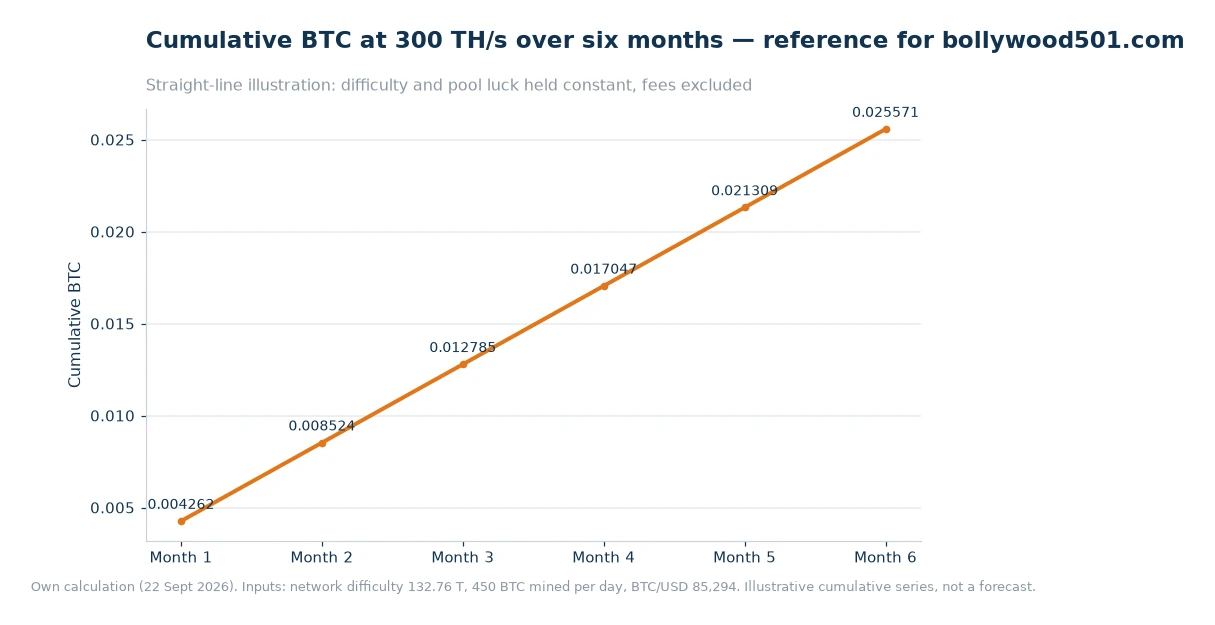
The straight line is the useful part, because it shows what the pool's block rhythm averages out to. Set against it, the daily sum the whole network competes for is $38,382,300 of issuance — 450 BTC at $85,294 — and no single operator collects more than a slice of that. The question for a miner is not who collects the most, but whether the slice you are paid for arrives in a shape your costs can absorb.
Reading concentration instead of guessing at it
Two numbers make the trade-off concrete for your own fleet. The first is the pool's share of network hashrate, which is visible as ViaBTC Pool Hashrate against the network figure. The second is Pool Luck, the rolling gap between blocks found and blocks expected; a long negative run there is what a small pool looks like from the inside.
If you are weighing a second location or a hosted site, the same concentration logic applies to physical infrastructure: the Mining Companies directory lists hosting operators, and Mining Farms covers the site side. Splitting hashrate between two of them is a real reduction in single-site exposure, and it costs you two site contracts, two power bills and two uptime reports to reconcile.
Frequently asked questions
Does a smaller pool pay less per TH/s?
No. Per-TH/s expected income comes from your share of network hashrate against the 450 BTC issued daily, and pool size leaves that unchanged. What changes is the spread of results and how long an unlucky run lasts.
Is concentrating all hashrate in one pool a bad idea?
It depends on what you can survive. One pool means one payout calendar, one fee tier and one set of records, which is simpler to run. It also means one dashboard, one node set and one support channel stand between you and your balance.
How many blocks should a healthy pool find in a month?
Multiply 144 blocks a day by the pool's share and by 30. A pool at 2% of network hashrate expects about 86 blocks a month, and a month with 70 or 100 is inside normal variation.
Where concentration actually bites
Write down what you would do if your pool's dashboard went dark for a day, if a payout were misattributed to the wrong worker, or if blocks stopped arriving for 12 hours. Each answer is a concentration decision that has nothing to do with the fee schedule. Keep your own records of delivered hashrate and expected credits so a discrepancy is visible within a day rather than at month end, keep the machines' firmware and pool credentials documented outside the pool's own interface, and review whether a second pool or a second site meaningfully reduces the single failure you are most exposed to. At 300 TH/s, one lost day is $12.12 of gross income — small. At 10 PH/s the same day is about $404, which is why the answer changes as fleets grow.
Data and sources: ViaBTC listed fee schedule[1] and the public pool statistics dashboard[2]. The 144-block daily pace, 450 BTC of daily issuance, difficulty of 132.76 T, network hashrate of 950.3 EH/s and a BTC price of $85,294 were taken from public chain data and market feeds, read 22 Sept 2026. Every figure quoted is arithmetic on those inputs, moves with difficulty and price, and is not a promise of earnings.